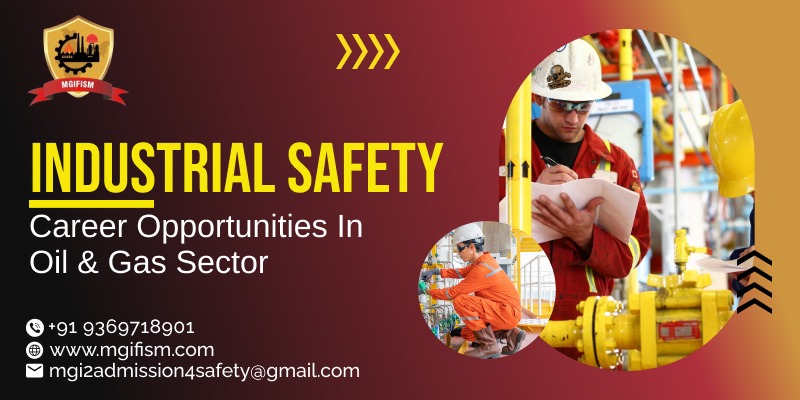
Industrial Safety Career Opportunities in Oil & Gas Sector - MGIFISM
Post By : Kritika
Post Date : 30 Jun 2026
Achieving success in your career becomes much simpler when you pick an industry with stability, high pay and constant development. The oil and gas industry is one of those rare industries that requires well-trained safety professionals at all times, as there have to be stringent health, safety, and environmental requirements for every operation. A company can't work without well-trained safety specialists.
These days, Career Opportunities for Industrial Safety in Oil and Gas Industry are growing fast in India, the Gulf countries and several other places around the globe. No matter whether it is a drilling rig, refinery, petrochemical unit, LNG terminal or any kind of pipeline, every industrial set-up requires skilled professionals for HSE (Health, Safety, and Environment). In case you would like to start your career in this domain, MGIFISM (Mahatma Gandhi Institute of Fire and Industrial Safety Management) offers training along with industry exposure and placements.
What is an Industrial Safety Course in the Oil and Gas Industry?
A successful career begins with appropriate training and knowledge. Appropriate safety training enables students to perform safely in hazardous industrial settings and also enhances their career opportunities. This course provides training on hazards identification, fire safety, risk assessment, emergency response, occupational health, use of personal protective equipment, safety auditing, and industrial legislation. At MGIFISM, not only theoretical but also practical training is imparted to the students, who can have successful career opportunities in the oil and gas industry after completing this course.
Why Industrial Safety Career Opportunities in the Oil & Gas Sector Are Growing?
Career security becomes much stronger when you enter an industry that continues to invest in infrastructure and safety. Over the last few years, India has expanded its refining capacity, natural gas projects, petroleum storage, offshore exploration, and pipeline networks. At the same time, Gulf countries continue to recruit thousands of qualified safety professionals every year.
With these changes, there have been greater Industrial Safety Career Opportunities in the Oil & Gas Industry. Every company needs to adhere to all workplace safety laws, environmental regulations, emergency response systems and risk management techniques. Consequently, a Safety Officer has become a necessity rather than a choice.
The increasing focus on zero accidents, employee welfare and environmental protection has also created long-term career opportunities for trained candidates.
Understanding Upstream, Midstream and Downstream Oil & Gas Jobs
A better knowledge about the industry would help the students select their career path. There are three main types of segments in the oil and gas industry, and all of them require safety experts.
- Upstream: Oil exploration, drilling, offshore rigs and extraction.
- Midstream: Transportation through pipelines, storage terminals and LNG facilities.
- Downstream: Refineries, petrochemical plants, fuel distribution and gas processing units.
Career Opportunities for Industrial Safety in the Oil & Gas Industry exist in all of these sectors. Industrial safety professionals keep track of risky jobs, perform inspections and put in place safety measures.
Top industrial Safety Officer Jobs in Oil & Gas industry
Professional qualification offers various career paths for students rather than confining them into one profession. Organizations employ safety professionals based on the nature of projects and their experiences.
Popular career options include:
- Safety Officer.
- HSE Officer.
- Fire Safety Officer.
- Safety Supervisor.
- HSE Engineer.
- Safety Auditor.
- Risk Assessment Officer.
- Occupational Health & Safety Officer.
- Environmental Safety Officer.
- Emergency Response Coordinator.
- Loss Prevention Officer.
- HSE Manager (with experience).
These Career Opportunities in Industrial Safety for Oil & Gas Industry can be availed at Refineries, Offshore Platforms, EPC Companies, Drilling Projects, Petrochemical Plants, Power Plants, Liquefied Natural Gas Terminals, Construction Firms and Manufacturing Industries.
Skills Required to Become an Industrial Safety Officer
Professionals' success is achieved through practical knowledge in addition to technical knowledge. It is always advantageous when employees have practical knowledge of industries and can handle occupational hazards in their workplaces competently.
For one to excel in Industrial Safety Career Opportunities in Oil & Gas Sector, it is advisable to cultivate the following skills:
- Hazard Identification
- Risk Assessment
- Fire Prevention & Protection
- Permit to Work (PTW)
- Job Safety Analysis (JSA)
- HAZOP Awareness
- Emergency Response Planning
- PPE Management
- Accident Investigation
- Safety Audits
- Industrial Safety Laws
- Occupational Health & Safety
- Environmental Protection
- Communication & Leadership
These practical skills make candidates job ready from the beginning of their careers.
Top Recruiters Hiring Industrial Safety Professionals
When you get trained by an established organization, there are more chances that you may be employed by big companies. The Oil & Gas sector recruits certified HSE professionals both domestically and internationally.
Some major recruiters include:
- ONGC
- Indian Oil Corporation (IOCL)
- Bharat Petroleum (BPCL)
- Hindustan Petroleum (HPCL)
- Reliance Industries
- Cairn Oil & Gas
- Adani Group
- Larsen & Toubro (L&T)
- Petrofac
- Saudi Aramco
- ADNOC
- QatarEnergy
- Shell
- ExxonMobil
Many EPC contractors that operate in the Middle East also hire Indian professionals that have industrial safety qualifications.
Salary Scope in Industrial Safety Career Opportunities in Oil & Gas Sector
Growing income is one of the biggest reasons students choose industrial safety as a profession. With the right qualifications, practical experience and additional certifications, salary packages increase steadily over time. Industrial Safety Career Opportunities in the Oil & Gas Sector offer competitive pay in both India and Gulf countries, especially for skilled HSE professionals.
Here is the structured salary and career progression breakdown based on experience levels across India and the Gulf region :
|
Job Role
|
Experience
|
Average Salary in India (Per Year)
|
Average Salary in Gulf Countries (Per Month)
|
|
Trainee Safety Officer
|
Fresher
|
₹2.5 – ₹4 LPA
|
AED 2,500 – 3,500 / SAR 2,500 – 3,500
|
|
Safety Officer
|
1–3 Years
|
₹3.5 – ₹6 LPA
|
AED 3,500 – 5,500 / SAR 3,500 – 5,500
|
|
HSE Officer
|
3–5 Years
|
₹5 – ₹8 LPA
|
AED 5,000 – 8,000 / SAR 5,000 – 8,000
|
|
Safety Engineer
|
5–8 Years
|
₹7 – ₹12 LPA
|
AED 7,000 – 10,000 / SAR 7,000 – 10,000
|
|
HSE Manager
|
8+ Years
|
₹12 – ₹25 LPA
|
AED 12,000 – 20,000 / SAR 12,000 – 20,000
|
Note: Salary figures are approximate and vary based on qualifications, certifications (such as NEBOSH), employer, project location, skills and work experience. Offshore projects and international assignments generally offer higher salary packages along with additional benefits.
Industrial Safety Courses at MGIFISM for Oil & Gas Careers
Selecting the right institution becomes one of the biggest decisions in life because quality education and training will make students ready for the industry.
The MGIFISM institute gives various courses related to industries like Fire & Industrial Safety, Occupational Safety, HSE, and Safety Management with certificate, diploma, post-graduate diploma, MBA and vocational courses.
Some popular programs include:
- Certificate Courses.
- Diploma in Fire & Industrial Safety.
- Post Graduate Diploma in HSE.
- MBA Fire & Safety Management.
- M.Voc Occupational Safety Training Program.
The M.Voc Occupational Safety Training Program is a two-year offline program which includes workplace safety, hazard recognition, fire safety, disaster management, safety audit, environmental safety and industrial legislation. Hands-on training is provided to students in the use of PPE kit, gas detectors, fire extinguishers, hydrant system and safety monitoring equipment.
Eligibility Criteria for Industrial Safety Course in Oil and Gas Industry
Meeting the right eligibility requirements is the first step toward building a successful career in industrial safety. Most institutes offer different programs based on a student's educational qualification, making it easier for freshers as well as working professionals to choose a suitable course.
Here is the structured overview of the safety course levels, eligibility criteria and target audience:
|
Course Level
|
Minimum Eligibility
|
Suitable For
|
|
Certificate Course
|
10th Pass or 12th Pass (varies by course)
|
Beginners, freshers and entry-level job seekers
|
|
Diploma in Industrial Safety
|
10+2 (Any Stream) or ITI (as per course requirements)
|
Students seeking technical safety skills
|
|
Advanced Diploma / PG Diploma
|
Graduation in any discipline or Diploma in Engineering (course-specific)
|
Graduates and working professionals
|
|
B.Voc / M.Voc Occupational Safety
|
As per university admission norms (12th Pass for B.Voc, Graduation for M.Voc)
|
Students looking for skill-based higher education
|
|
MBA in Fire & Safety Management
|
Bachelor's Degree from a recognized university
|
Graduates aiming for managerial and leadership roles
|
|
International Safety Certifications (NEBOSH, IOSH, etc.)
|
12th Pass or Graduation (recommended, depending on certification provider)
|
Professionals planning careers in India and the Gulf countries
|
Note: Eligibility criteria may vary depending on the course and institute. Before applying, students should verify the specific admission requirements with the institute.
Why Choose MGIFISM for Industrial Safety Career Opportunities in Oil & Gas Sector?
A reputed institute builds up the confidence level before students step into the professional world. Learning through experience from practical exposure enhances employability and interview skills.
MGIFISM is recognised for its:
- Industry-oriented curriculum
- Experienced faculty
- Practical training methodology
- Modern safety laboratories
- Workshops and industrial visits
- Placement assistance
- Affordable fee structure
- Updated HSE curriculum
- Career counselling support
Students trained at MGIFISM work in refineries, petrochemical plants, EPC companies, offshore projects and Gulf countries. During training, they gain hands-on experience with fire extinguishers, gas detectors, PPE, safety audits and mock drills.
Career Growth Path in Industrial Safety
An industrial safety career will see you learning all through as you get promoted. Experience helps one move up the ladder to become leaders/managers.
A typical career path looks like this:
Trainee Safety Officer → Safety Officer → HSE Officer → Senior HSE Officer → Safety Engineer → HSE Manager → Corporate HSE Head.
Certifications and experience gained through projects can help in improving career opportunities, particularly in multinationals and countries of the Gulf region.
Why Is Industrial Safety a Future-Proof Career?
Industrial Safety is one of the rapidly growing careers, since all industries require qualified safety professionals who will help maintain safety standards and comply with the regulations.
Why should you choose such a career?
- There is high demand for it in the Oil & Gas, Construction, Manufacturing and Power industries
- Safety-related laws ensure that there are job openings constantly
- Good salary levels and career progression
- Great job prospects in the Gulf States
- The skill set remains in demand even when technology changes
- Career progress from Safety Officer to HSE Manager and further
Future Scope for Industrial Safety Careers
There is an expectation of a continued requirement for Industrial Safety professionals due to expansion in industries and increasing standards of workplace safety. There will always be new industries and projects that will provide career openings.
Future career prospects are as follows:
- Oil & Gas, Refineries and Petrochemical Plants.
- Renewable Energy and Green Hydrogen Projects.
- Infrastructures, Metro, Highway and Smart City Projects.
- Manufacturing, Pharmaceuticals and Chemical Industries.
- Logistics, Warehouses and Data Centers.
- ESG, Sustainability and Corporate Safety Management.
- HSE Engineer, HSE Manager, Safety Consultant and Corporate HSE Head.
Conclusion
Industrial Safety presents some of the best career options for students and working individuals who seek job security, career advancement and high earnings. Whether it is a refinery, a petrochemical plant, an offshore oil rig, power projects, manufacturing industries or even the Gulf countries, Safety Officers and HSE specialists are needed everywhere in the industrial sectors.
Selection of an appropriate training institute plays an important role in establishing a successful career.
MGIFISM equips its students with courses suited for the industrial needs, experienced teaching staff, state-of-the-art safety laboratories, practical training, industrial visits and placements.
If you intend to build your career in Industrial Safety, contact us and get information about courses, eligibility criteria, admissions procedure, fees and career counseling services. Call us at +91-9369718901.
Frequently Asked Questions
1. What are Industrial Safety Career Opportunities in the Oil & Gas Sector?
Industrial Safety Career Opportunities in the Oil & Gas Sector include Safety Officer, HSE Officer, Fire Safety Officer, Safety Engineer, and HSE Manager roles across refineries, offshore platforms, pipelines, and petrochemical industries.
2. Is Industrial Safety a good career in the Oil & Gas Sector?
Yes, Industrial Safety offers stable jobs, attractive salaries, career growth, and international opportunities because oil and gas companies always require qualified professionals to maintain workplace safety and legal compliance.
3. Which course is best for Industrial Safety Career Opportunities in the Oil & Gas Sector?
Diploma, PG Diploma, M.Voc Occupational Safety, MBA Fire & Safety, and HSE courses with practical training are excellent choices for building Industrial Safety Career Opportunities in Oil & Gas Sector.
4. What is the eligibility for the Industrial Safety Course in Oil & Gas Industry?
Eligibility depends on the selected course. Students with 10th, 12th, ITI, Diploma, or Graduation can apply for different Industrial Safety courses offered by recognised institutes across India.
5. What is the salary after an Industrial Safety Course in the Oil & Gas Sector?
Freshers generally earn ₹2.5–₹4 lakh annually in India. Experienced HSE professionals and Gulf employees receive significantly higher salaries with additional project allowances and employment benefits.
6. Which companies hire Industrial Safety professionals in the Oil & Gas Sector?
Companies like ONGC, IOCL, BPCL, HPCL, Reliance Industries, Cairn, Saudi Aramco, ADNOC, Shell, Petrofac, and L&T regularly recruit qualified Industrial Safety professionals.
7. Can freshers get jobs after doing an Industrial Safety course?
Yes, freshers with recognised Industrial Safety qualifications and practical training can secure entry-level positions like Trainee Safety Officer or Safety Supervisor in various industrial projects.
8. Is an Industrial Safety Career in the Oil & Gas Sector good for Gulf jobs?
Yes, Gulf countries continuously recruit certified Safety Officers and HSE professionals for refinery, offshore, construction, petrochemical, and pipeline projects with attractive salary packages and benefits.
9. Which skills are required for Industrial Safety Career Opportunities in the Oil & Gas Sector?
Students should learn hazard identification, fire safety, emergency response, risk assessment, safety audits, occupational health, industrial laws, communication skills, and environmental protection for better employment opportunities.
10. What is the duration of the Industrial Safety Course for the Oil & Gas Industry?
Course duration varies from six months to two years, depending on the selected certificate, diploma, postgraduate diploma, vocational, or degree program offered by the training institute.
11. Can Mechanical Engineers join Industrial Safety Career Opportunities in the Oil & Gas Sector?
Yes, Mechanical Engineers can pursue Industrial Safety courses and build successful careers as Safety Engineers, HSE Officers, or Safety Managers in oil and gas companies worldwide.
12. What subjects are covered in the Industrial Safety Course?
The course includes fire safety, hazard identification, risk assessment, occupational health, safety audits, emergency response, disaster management, PPE, environmental safety, and industrial safety regulations.
13. Are Industrial Safety jobs available in India?
Yes, Industrial Safety professionals are required in refineries, petrochemical plants, power projects, manufacturing industries, construction companies, logistics facilities, and oil exploration projects throughout India.
14. Why choose MGIFISM for an Industrial Safety Course?
MGIFISM offers an industry-focused curriculum, practical training, experienced faculty, modern laboratories, placement support, and career guidance, helping students prepare for successful Industrial Safety careers in India and abroad.
15. Does MGIFISM provide placement support for Industrial Safety students?
Yes, MGIFISM provides placement assistance, career counselling, interview preparation, and industry guidance to help eligible students explore Industrial Safety Career Opportunities in the Oil & Gas Sector.
16. How do I apply for an Industrial Safety Course at MGIFISM?
Students can contact MGIFISM directly for admission guidance, eligibility details, fee structure, available courses, and counselling by calling +91-9369718901 during official working hours.





 Request a Callback
 Call Us
 WhatsApp