
Portfolio Excellence
Awarded to students with outstanding creative & technical portfolios.
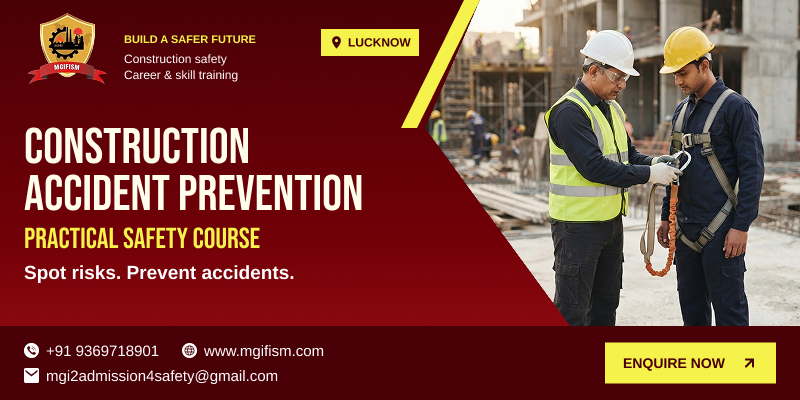
There are numerous activities done at construction sites like working at heights, operating heavy machinery, using electrical equipment, and moving construction materials among others. Without any safety measures put in place, there is a likelihood of these activities causing injuries. In this regard, a Construction Accident Prevention Course provides knowledge on common hazards on the job site and the ways of avoiding them. MGIFISM provides fire and safety training programs that will be of great importance to the learners as far as developing safety skills is concerned.
A Construction Accident Prevention Course is a training course that helps trainees learn about recognizing hazards and preventing accidents on construction sites. This includes topics such as safe work practices, proper safety equipment usage, and basic risk management. The training course ensures that the worker is able to be aware of his responsibilities and adhere to safety guidelines while he performs his job tasks. It will also assist the supervisor in ensuring safety in the team. MGIFISM offers fire and safety training for individuals who wish to enhance their knowledge about workplace safety.
Construction work has some elements of risk that may be dangerous not only for the employees but also for other people involved in this process, including the supervisor, contractor, and visitor. Construction safety training will enable people to identify dangerous situations before any harm is done. Besides, safety training will help workers learn how to behave according to the safety regulations and operate construction equipment. Taking prompt measures may help to avoid injuries, delays, and possible damage to expensive construction equipment and materials.
A Construction Accident Prevention Course teaches the hazards at construction sites and how to handle them. The learners acquire information about risk assessment, fall protection, electrical hazards, fire prevention, and emergency planning. The other things that are taught include proper handling of equipment, use of personal protective clothing, reporting hazards, and workplace inspections. All these topics help the learners know how to assess hazards before engaging in any activity and how to react to them. The topics covered may vary from one training institution to another.
Risk identification and risk assessment enable employees to be aware of dangers like falling objects, moving machinery, and exposed wiring. They learn how to assess risks, report the hazards, and take appropriate safety precautions.
The fall prevention training enables workers to perform their jobs safely when working at heights. This includes using guardrails, safety harnesses, fall protection devices, and inspections in order to avoid accidents.
Safety training for scaffolding involves a stable work platform, safe usage of ladders, weight limitations, and dangers associated with excavation. Workers should be able to examine equipment and recognize the danger of ground collapsing.
Electrical safety training helps workers identify damaged cables, exposed wires, and unsafe connections. It also includes equipment inspection, safe operation procedures, and reporting faulty equipment to avoid any injuries or accidents at work.
Through PPE training, workers learn how to use, choose, wear, check and take care of safety helmets, gloves, protective shoes and safety glasses. Using appropriate protective equipment decreases the risk of being exposed to dangers at the workplace.
Training in fire safety makes workers know how to spot fire hazards, keep emergency exit ways open and follow emergency procedures. Fire alarm, appropriate extinguishers, evacuation plans and emergency procedures at construction sites are discussed as well.
In an accident investigation course, students are taught how to prepare accident reports and near misses. Students become acquainted with reporting procedures and the value of accident records.
Safety inspections at a construction site aid in identifying hazards relating to machinery, scaffolding, electricity, and emergency exits. The toolbox talks will enable the learners to get guidelines for safety before commencing work.
A construction safety course is beneficial to those who are in the construction business, maintenance work, infrastructural projects, and similar activities. This course will help trainees understand their safety duties and identify the different hazards at work.
Ideal trainees are:
The required level of training might differ depending on the specific job, among other factors.
Proper training ensures that the workers get an understanding of the impact of their day-to-day decisions on the level of safety within the workplace. Accident prevention training supports better awareness, safer working methods, and timely reporting of hazards.
The most significant benefits include:
A construction accident prevention course will entail lectures, case studies, and assessment. The mode of training will depend on the educational institution.
The process includes:
The duration and requirements for enrollment in a construction safety course will be determined by the course outline and mode of training. Basic training programs will be of shorter duration, while advanced training might take longer. The learner should verify the specifics of the course with MGIFISM.
|
Course detail |
General information |
|
Eligibility |
Depends on the course level and provider |
|
Educational requirements |
Vary by programme |
|
Course duration |
Confirm with the training institute |
|
Training format |
Classroom, online, practical, or blended, where available |
|
Assessment |
May include written tests or practical evaluation |
|
Certificate |
Subject to course completion and provider requirements |
|
Documents |
Identification or educational documents may be required |
These details should be verified with the institute because course availability, duration, and certification conditions can differ.
The right construction safety training will allow one to get some knowledge for safety tasks. The value of a certificate is determined by the content of the course, the process of evaluation, the issuing organisation, and the requirements of employers. The training itself does not guarantee qualification for all jobs in the field because some of them have higher educational requirements.
Some of the jobs are:
Learners need to know the qualifications for the desired job in advance.
The importance of Workplace accident prevention training lies in enabling workers to work safely in various settings like construction sites, workshops, factories, and maintenance centres. The topics covered include hazard identification, safe equipment handling, emergencies, housekeeping, and incident reporting. The training should be in line with the hazards that exist in the workplace and not just general instructions. The employer is supposed to give specific instructions for a task, provide protective gear, supervise, and conduct safety evaluations.
An online construction safety course will assist the student in researching important safety issues from a convenient point, depending on the learning resources that have been made available by the particular course provider. Online courses may offer such subjects as hazard recognition, personal protective equipment, fire prevention, emergency management, and incident reporting. Some subjects require demonstration or assessment exercises that may not entirely be done through online research. Verify these aspects before taking the course, including the availability of an online course on MGIFISM.
MGIFISM is a fire safety institute, and it provides training programs for individuals who would like to have training on how to achieve safety at work place. Those individuals who wish to undergo a construction accident prevention training program should go through the program syllabus and ensure that it meets their career objectives.
The reasons why one should get in touch with MGIFISM are:
Contact the institute directly to verify course availability, fees, practical sessions, and certification arrangements before making a decision.
To find a Construction accident prevention course near me, one must first determine a training institute that provides appropriate safety classes and training options for learners. One needs to consider the location of the institute, schedule of the courses, contents of the course, and training facilities before joining the institute. One should also verify if the course will include practical sessions and if the certificate from the course will be accepted in your workplace. Students in Lucknow and elsewhere can get in touch with MGIFISM for more information on the programs they offer.
Developing good safety awareness is one of the ways of avoiding accidents and ensuring the safety of construction workers. A good construction health and safety course will allow the learner to know the various hazards involved, how to follow safety procedures, and react appropriately in case of an emergency. You should check the various aspects of the course before you enroll.
MGIFISM can be reached via phone at +91-9369718901 regarding construction accident prevention and fire and safety training. They can provide you with information about the different courses and other related information, including fee structure.

We offer: M.Sc Fire & Safety M.Tech Fire & Safety MBA Fire & Safety Management M.Voc Occupational Safety These programs are designed for students who want leadership roles in safety management, consultancy, and international c...

We Offer: B.Sc Fire & Safety B.Sc Occupational Health & Safety (OHS) B.Voc Programs B.Tech Programs These courses build a strong academic and practical foundation for long-term career growth....

Engineering Diploma in Fire Safety ADIS (Advanced Diploma in Industrial Safety) Diploma in Health, Safety & Environment Diploma in Fire Safety PG Diploma in Fire & Safety Construction Safety Diploma These are among the most popul...

Certificate in Fire Safety Certificate in HSE Certificate in Fire Technology Short-term BSS Certifications Perfect for beginners or professionals looking to upgrade skills quickly....

IOSH Managing Safely OSHA Construction Safety First Aid Certification Risk Assessment Accident Investigation Work at Height Safety Confined Space Safety Scaffolding & Rigging Safety Fire Safety Awareness These short-term progra...
Expert Trainers
Happy Students
Total Courses
ACS is an initiative by the team of ex-Niftians, alumni’s and experienced professors...

At MGIFSM, we offer some of the best diploma and degree courses in Fire and Industrial Safety Management and HSE. Our curriculum is carefully designed to meet current industry standards and global safety requirements. We ensure that our students are not just academically strong but also industry-ready. The course structure includes a perfect balance of theory and practical learning, enabling students to understand both concepts and their real-life applications. Our programs are continuously updated to match the latest safety regulations, technologies, and practices followed in industries such as oil & gas, construction, manufacturing, power plants, and more.
Show More
Safety is not just a subject—it is a responsibility. At MGIFSM, we emphasize Health, Safety, and Environment (HSE) as a core part of our training. Students learn: Workplace hazard ,identification, Risk assessment and management, Environmental protection techniques, Occupational health standards, Emergency response planning, This comprehensive approach ensures that our students become responsible professionals who can maintain safety standards and protect lives in any working environment.
Show More
Every student is unique, and so is their learning journey. At MGIFSM, we follow a personalized training model: Individual student assessment (SWOT analysis), Customized learning strategies, Tailored study plans, Continuous monitoring and feedback. This approach ensures that each student receives the support they need to overcome weaknesses and enhance their strengths.
Show More
Our faculty members are highly qualified, experienced, and dedicated to student success. They bring real-world industry experience into the classroom, making learning more practical and engaging. They don’t just teach—they mentor, guide, and inspire students to achieve their goals. Regular doubt-clearing sessions, one-on-one mentoring, and interactive teaching methods make learning effective and enjoyable.
Show More
At MGIFSM, we believe that practical knowledge is the key to success in safety management. That’s why we focus heavily on hands-on training. Students get exposure to: Firefighting equipment and techniques, Safety drills and mock exercises, Industrial safety tools and practices, Emergency response simulations. This real-world training helps students build confidence and prepares them to handle critical situations effectively.
Show More
We provide a well-equipped learning environment with modern infrastructure, including: Practical training labs, Safety equipment, Audio-visual classrooms, Updated study materials. Our facilities are designed to create a professional learning atmosphere where students can focus, learn, and grow.
Show More
Our commitment doesn’t end with education—it extends to your career. MGIFSM provides strong placement assistance and career guidance. We help students with: Resume building, Interview preparation, Job opportunities in safety sectors, Industry connections. Our goal is to ensure that every student gets the opportunity to start a successful career.
Show More
Fire and Industrial Safety professionals are in high demand across various industries, including: Oil & Gas, Construction, Manufacturing, Power Plants, Chemical Industries, By choosing MGIFSM, you step into a career path that offers stability, growth, and global opportunities.
Show More
Apart from technical knowledge, we focus on: Communication skills, Personality development, Leadership qualities, Confidence building. This ensures that our students are not only skilled professionals but also confident individuals ready to face real-world challenges.
Show More
Awarded to students with outstanding creative & technical portfolios.

Recognised for creativity in architectural drafting competitions.

Awarded for excellence in national-level design portfolio competitions.
ACS is an initiative by the team of ex-Niftians, alumni’s and experienced professors...

Our ultimate goal is your success. With strong training and industry-oriented skills, students are prepared for job opportunities in fire safety, industrial safety, and related sectors.

Students are evaluated through a comprehensive assessment system that includes: Written Tests, Practical Exams, Viva (Oral Examination), Projects, Presentations. This ensures complete preparation for real-world challenges.

Our experienced trainers implement the plan through structured classes, hands-on practical sessions, real-life simulations, and continuous mentoring.

Every student receives a personalized training plan, which includes theoretical learning, practical exposure, and soft skill development to ensure overall growth.

We design a customized strategy for each student, focusing on skill enhancement, technical knowledge, and confidence-building to meet industry standards.

Students are grouped according to their learning level and capabilities. This allows us to provide focused training, ensuring no student is left behind and everyone progresses effectively.

Your journey begins with a smooth and transparent admission process. Our counselors help you understand course options, career scope, and guide you in choosing the right program based on your interests and goals.

We conduct a detailed SWOT Analysis (Strengths, Weaknesses, Opportunities, and Threats) to understand each student better. This helps us create a strong foundation for personalized learning and career planning.

Our expert team evaluates each student’s academic background, skills, personality traits, and areas of improvement to ensure the right training approach is adopted.

Excellent Services for specialized Safety profession and I would like to recommended to take a courses in MGIFISM.

It's brain child of a specialized Safety profession and highly recommended to take a courses in MGIFISM

Leave your details and our training consultant will get back to you


 Request a Callback
 Call Us
 WhatsApp